Wednesday, 30 January 2008

Chichicastenango

Sunday 26th January

The place with the unpronounceable name. Well almost, it has taken me nearly 4 months and a visit to the place itself to learn to pronounce it correctly. It was always that 'cas' in the middle that threw me each time. Now I'm fluent and ready to take on saying town names such as Chimaltenango and Quetzeltenango - no problem!

Chichi Flower Seller
Chichi market

Thousands of Mayans from the surrounding area and dozens of tourists shipped in from Antigua and Pana come to Chichi every Thursday and Sunday for the massive market. It is a riot of colour as most of the women and some of the men still wear traditional handwoven clothes, with designs differing from one village to the next. The market fills the main square and church steps and comes in four parts - the covered fruit and vegetable market, the main part of the square and surrounding streets selling everything from ceremonial incense to cheap clothes via hardware and live turkeys, the flower market on the church steps and finally the market for the tourists selling textiles, masks and woodcarvings. The first three are almost solely for Mayans and the core of the square are a group of cheap eating places.

Chichi Textiles
Chichi Textiles

We tourists really only drift around the edges of this temporary village even though it is one of the main tourist destinations in Guate. It never felt like a zoo when I was there as there are just so many Mayan people doing what they are there to do. And with the place being so packed they don't hold much quarter trying to get around static tourists looking confused or taking photos.

The whole market is extremely exciting and dynamic and if you can find a spot to one side to watch it, it is mesmerising.
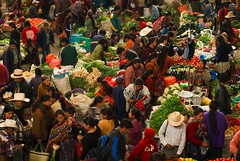
Chichi Fruit and Veg
Better than Tesco anyday.

One of the main events of Sunday is morning mass in the Catholic church. Except this church integrates traditional Mayan rituals with Catholicism. Elders from the town and surrounding area attend on mass, the priest reminds them all that whatever way they worship it is Christ they come for, then after he finishes people light candles and murmur on 12 square altars laid along the aisle from the front to the back of the church. Many people also burn incense before entering the church to bless the spirit of the church itself.

Getting There
I went to Chichi by chicken bus from Antigua. You get the buses from behind the market. You first take a bus to Chimeltenango, then a bus to Los Encuentros and then the final bus to Chichi. There was no wait at any of the changes and the buses are quick! The final stretch is a half-hour ride up and down steep roads with tight zig-zag bends that the drivers take at speeds Michael Schumacher would find difficult to match while the conductors lean out of the door shouting at every other vehicle to get out of their way. The bus ride is an experience in itself.

Accommodation
I stayed in the basic and cheap Posada Belen on one side of town. The balconies overlook a wooded ravine on one side and the town on the other. It is nothing fancy but rooms are large. The shared shower had hot water two days out of three.
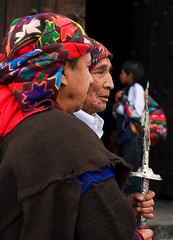
Chichicastengo Elders
Mayan elders attending mass

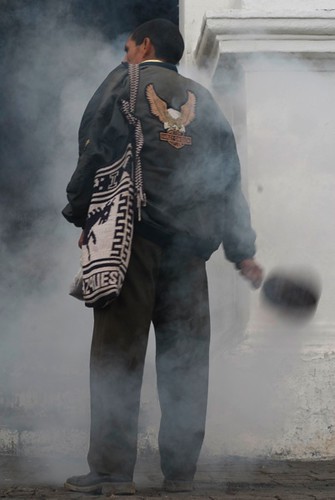
Incense Spirit
Blessing the spirit of the church. Note the Harley Davidson jacket!
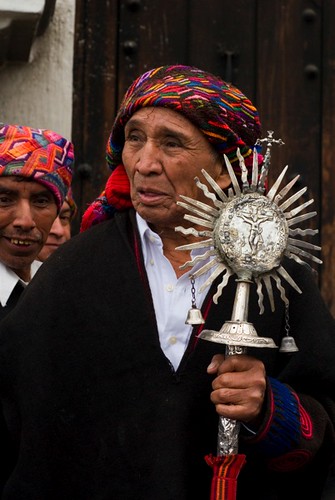
Chichicastengo Elders 2

Tuesday, 29 January 2008

Antigua

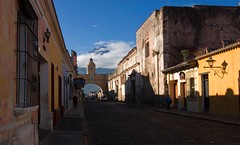
Antigua Arch
View through the Arch to Volcano Agua

Antigua is a fantastic old historic Spanish colonial city. Low buildings, flat, bright colours, cobbled streets, big doors, looming cathedrals, grid lay-out. Plus plenty of abandoned churches and buildings left unrepaired from the earthquake in the 1770s.

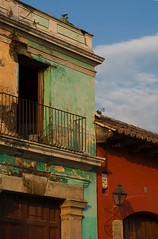
Antigua Door
A typically impressive Antiguan door

Plus a plethora of cafes, restaurants and bars - many set in delightful courtyards fringed with arched cloisters and brimming with flowering plants. It is a food and drink delight set in stylish surroundings. I made the most of the great numbers of delicious cakes on offer. It is a place to wander from old building to old building, a tea, coffee or hot chocolate in a cafe and to drop in to a gallery or museum. We stopped by one art exhibition opening, found a great open air courtyard restaurant/bar with a great band, and explored the ruined cathedral which is Escher like in the way its surviving arches and their shadows intersect. It is like Barcelona without the modern bits.

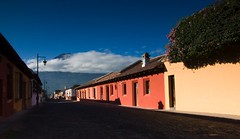
Antigua Street
A typical Antiguan street

Add to this three volcanoes looming overhead, one still active and periodically emitting smoke, for a very special town indeed.

Antigua Potluck

We stayed in a beautiful room in a casa which was way over our budget but we can save a bit later. It was worth it for the rooftop terrace - great views and yoga space - nice rooms and quiet. No drunken backpackers talking rubbish in an adjacent courtyard until late into the night. My we're getting old!

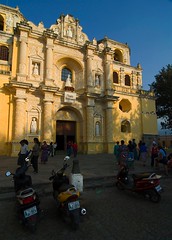
La Merced
La Merced

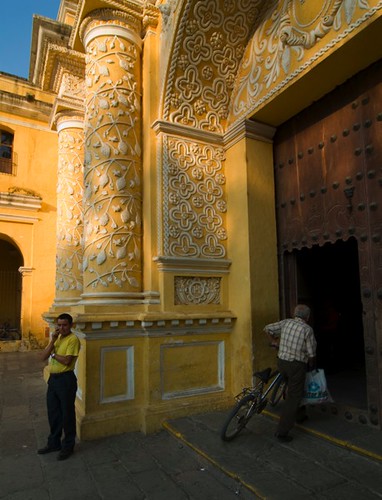
We were very close to the awesomely ornate La Merced church who's bells rang out for mass at 6 - both in the morning and at night. Outside was a great place to buy pupusas at the weekend - cheese filled maize tortillas with salad, refried beans, guacamole and chilli.

Bicycle to Church
Taking your bicycle to mass

The other main standing church is the cathedral by the park.

Antigua Cathedral
Cathedral Traffic Lights

Antigua Sentinel
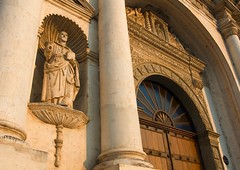
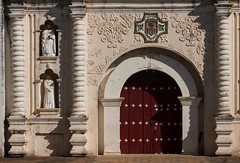
Cathedral Saint and Door

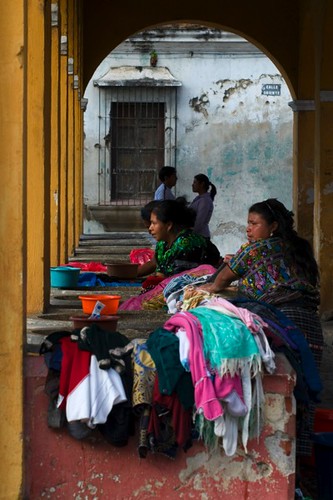
There are also well-used public pilas in the city. These are washing stations for clothes. Most villages and towns have, or had them, though more and more people have their own at home. Even the Antigua pilas are stylish!

Antigua Pilas

I would happily return to Antigua to live for a few months and spend plenty of time walking around the streets taking photographs, going to see live bands and putting on weight from eating too many cakes.

One Way Antigua

Saturday, 19 January 2008

Copan Ancient Mayan City

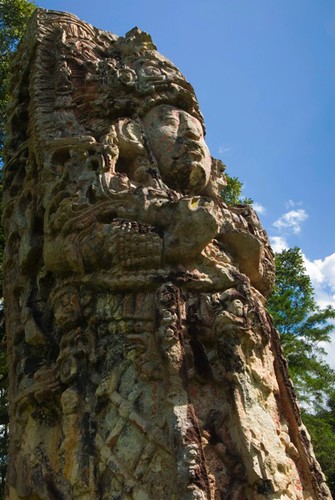
Two Stelae, One King, Eighteen Rabbit
Copan

I visited the ruins of Copan on 8 days during our stay at Copan Ruinas. Somewhat confusingly the modern town is known as Copan Ruinas, though its real name is San Jose de Copan, rather than the archaeological site which is known as Las Ruinas. I’ll just use Copan for the archaeological site and ‘the Town’ for, well, the town from now on.

Stella H
Stella H

Copan is the municipal park of Mayan cities compared to Tikal’s jungle fastness. The site is compact and the main area comprises a beautifully kept level lawn surrounded by trees that are reached by low yet very, very long flights of stone steps. This is the Gran Plaza that stretches north of the Acropolis. Perhaps the biggest comparison with anything in Britain is with the Yorkshire Sculpture Park.

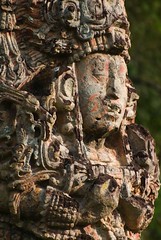
Stella N
Stella N

For it is across this lawn that Copan’s biggest contribution to world culture or tourist attraction, depending on how you view these monuments, are arranged. These are ten massive stone sculptures of the Kings of Copan. Such sculptures, known as stelae, are a feature of Mayan religious and socio-political art. A stela depicts a king or major city event and is inscribed with Mayan hieroglyphs that convey the important person or event the stela was made and erected for. There is always an altar in front.

Stella H
Stella H

The stelae of Copan are one of the biggest and best-surviving Mayan groups anywhere. Their real importance is that deep relief carving was not taken to such a high artform anywhere else in the Mayan world. This is in part due to the volcanic stone that is hard when first quarried then hardens on exposure to air to create a very long-lasting rock. Nearly all other Mayan cities are on limestone and the carving never reached the same depth of relief or survived the elements for long.

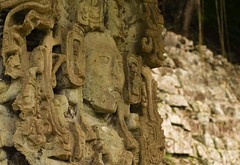
Glyphs 2
Is that a rabbit?

There are stelae throughout the whole of Copan but it is in the Gran Plaza that they are closely arranged. Seven of the ten were erected and so depict one king – known as 18 Rabbit because of the lupine resemblance of one hieroglyph. Over a number of years he created a procession route for public ceremonies that is now the de facto ancient sculpture park. Each is about twice the height of a person and bare the king dressed in religious costumes tailored full of cosmological meanings. It looks like he is tweaking his nipples while blessed out on a Class A drug. In fact he is holding a staff across his chest from the ends of which exit the sun deity in various anthropomorphic forms. His face is below a mask, which on each stelae represents a different god, and is surrounded by other deities. One has two stylised macaw beaks, which some earlier ‘scholar’s took for elephant trunks and evidence for cross-Pacific communication.

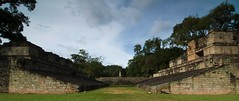
Ball Court
Ball Court

The other two main features of the plaza are the ball court and Hieroglyphic Stairway. The ball game was played throughout ancient MesoAmerica and involved teams using their hips, chests and shoulders to throw a solid rubber ball onto sloping stone sides with the aim of scoring through a hoop while watched from above by the nobility. The game re-enacted Mayan cosmology such as the passage of the sun through the Underworld and winning or losing teams either forfeited jewellery or their lives in sacrifice to the gods. The Stairway comprises glyphs written on the individual blocks of the steps and is the longest piece of ancient Mayan text.

South of the Plaza des Estella rises the stone Acropolis, an artificial mountain aligned on the cardinal points. Here is the heart of kingship and government in Copan. Two raised plazas hosted more private ceremonies for nobility and the nine governors of the regions commanded by the city. All nine governors and the king would meet regularly in the Popol Nah, or Mat House, Copan’s town hall. It is called a Mat House because it was were leaders brought their mats to sit on in front of the person who had the right to sit on the very front mat. This form of council was the basic elder-led administration in any community and was replicated in Copan’s Popol Nah at the city-state level.

Macaw Monument
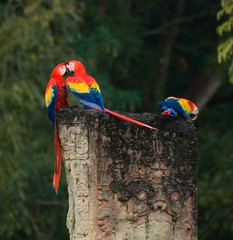
Macaws on a King

One of the delights of Copan is the group of ten or more semi-tame macaws that hang out near the ticker office and occasionally erupt into the plaza in a riot of colour and calls. They did this twice while I was there, once sitting on top of a stelae to search around and preen each other.

My week of photography at Copan was greatly enabled by Rene Viel, a French archaeologist who lives in Copan, and Oscar Cruz, the manager of the archaeological park. Oscar granted me a week's free access to the site and two museums as a result of Rene requesting access for me. Thank you to you both.

All-in-all, it was a very enjoyable week during which I got to know the personalities of Copan and hopefully have brought them out in the photographs.

Thursday, 17 January 2008

Antigua

We are now in Antigua Guatemala, the third colonial Spanish capital of Guatemala before yet another earthquake forced a move to the capital´s present geologically stable location in the 1700s. The town is all single storey Hispanic colonial buildings and cobbled streets with views of two volcanoes.

We´re looking forward to exploring the historic buildings, cafe culture and volunteering for the PROBIGUA literacy project by taking photographs and doing interviews of people who have benefitted from their support for promotional use.

We´re also hiking up a live volcano on Saturday!

Monday, 31 December 2007

Community Tourism in San Juan

29th - 31st Dec

Homestay and guided tour in the Lenca Highlands, Honduras

Dos Hombres
View from our homestay door

I am sitting looking over coffee plants and chickens eating a salted taron grapefruit while the slap, slap of fresh tortillas being made comes from the kitchen where Doña Soledad is making my lunch. It is 11am New Year’s Eve and we are coming to the end of a visit to the tourism co-operative of San Juan, a village south of Gracias. We are staying in Doña Soledad’s house, a hearty and jovial 84 year-old who welcomed us in with a hug and a kiss. She spends most of her day in the kitchen, beside the wood burning hot plate. Her husband goes out to milk their cows, her adopted son Leonardo to work their land full of coffee plants, bananas, beans, maize and other fruits and vegetables. Meals have been mostly of food from her own land, much of it organic, including freshly squeezed milk, cheese, curd cheese, beans, bananas, free range yard eggs, coffee and maize tortillas.

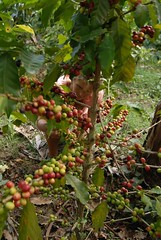
Ggeorgia picking coffee
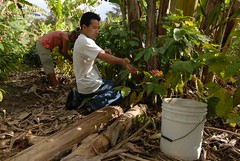
Georgia picking coffee

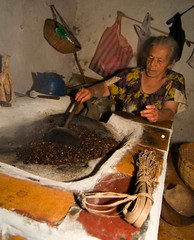
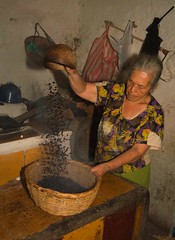
We made tortillas with her the first night. I would say ‘helped’ except for the mis-shapen attempts we produced. On the last day she demonstrated how she roasts coffee beans on her hot plate and we helped turn the beans so that they did not burn. As they roast, the smell comes increasingly of coffee, except in our case and because of our 'help' it was dominated by a heady aroma of charcoal.

Roasting Coffee
Roasting the coffee beans

Fresh Roasted Coffee
That's fresh coffee!

Soledad’s daughter Gladys runs a stationers cum button shop cum café which quadruples as the visitor centre for the co-operative. This was where we arrived to and were shown a well-produced information folder that explains the aims of the co-operative, how it benefits its members and the activities provided through it.

Leonardo picking coffee
Leonardo, Soledad's son, and Georgia pick coffee

Over the last couple of days we have got to know them all, especially Doña Soledad, and so got much closer to Hondurans than before. The co-operative is only four years old and was founded due to the plummeting coffee prices on the international market. With declining incomes a group of villagers and a Peace Corps worker identified the sorts of activities and infrastructure needed to increase small-scale community tourism. The current twenty members of the co-operative earn much needed income but also the visitor learns much more about contemporary and traditional Honduran life than if simply passing through and staying at a hotel. We have certainly got to know the people and lifestyles very well.

Danilo and Campesinos
Danilo our guide and Campesinos

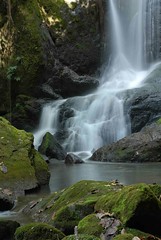
We had a full-day 24km hike into the mountains yesterday to visit the Waterfalls of the Elves. While not seeing any elves we did spend a great day with Danilo, a small farmer who as a guide earns 50% over the average daily wage for a coffee worker. Not only did we learn about the plants and history of the area, we were introduced to other members of the community and felt like we were being right in a real part of Honduras.

Waterfall of the Elves
A waterfall, no elves in sight!

More photos are on our flickr photostream, link above left.

Thank You Gracias

26th-29th Dec

Capital of the Lenca Highland, Honduras

Gracias
Gracias

Gracias church
One of the Gracias churches

Gracias is a small mountain town in the western Highlands of Guatemala, an area occupied by the indigenous Lenca people. The bus journey from the coast rose through ever-more stunning countryside flanked by high mountains. We met a British-Irish couple who now live in San Francisco on the bus and shared stimulating conversations to pass the four hour journey. On arrival, we hopped in a tuk-tuk to the Finca Bavaria, a German-Honduran owned small walled coffee finca and hotel on the edge of town. Our room was set in a beautiful but somewhat neglected garden of forest trees, flowers, bananas, mangoes and coffee plants, all hidden behind a high stone wall and foreboding black steel gates – German style. The family who run the finca for the owners comprise a friendly but somewhat dotty hombre, a scowling senora and their pleasant, smiling daughter. The gates were purportedly closed at 10pm, to be opened on knocking, but were closed by 9.30 and opened with comments of ‘ooh, isn’t it late?’

Chat Up
Gracias Chat Up

The town is a small grid pattern of low pan-tiled painted houses, with a labyrinthine market at its centre. Two white Hispanic churches are the highest buildings in the town, one of them set next to a small wooded park. It gets its name from its founder, Spanish Conquistador Juna de Chevez, who called it Thank You to God when he came to this part of Central America in 1536. It is one of the oldest towns in Honduras, and has twice been it capital albeit briefly. An indigenous Lenca revolt against Spanish rule was brutally put down here when the Lenca leader Lempira was murdered on the pretence of an invitation to peace talks. He is now a national hero and his name is the name of the Honduran currency.

Lenca Hombre
Lenca Hombre

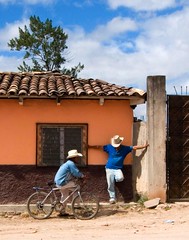
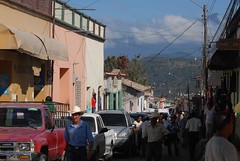
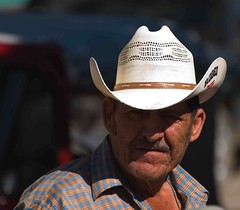
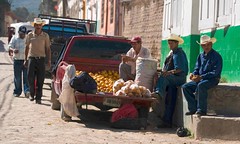
Gracias doesn't get many tourists which means that there is a different atmosphere in town than elsewhere we have visited so far. People are going about their normal lives and as visitors we can see what that means in Honduras rather than solely being on holiday mode and seen by locals as a source of cash. One feature is that there are lots of men in cowboy hats.

Oranges are the only fruit

The market is a delight to explore and buy tortillas, fruit, vegetables and cheese. The outer walls are honeycombed with small shops selling everything from saddles and hardware to clothes and plastic things. Gracias is a place to wander around aimlessly and absorb how people live in highland Honduras. We also climbed to the nearby 19th century Castillo and spent an afternoon in hot springs situated 8km outside the town in a wooded gorge. A group of American and British backpackers arrived mid-afternoon and we shared beers over conversation – the ideal way to enjoy communal bathing. The only issue being the overly-amplified music which was further let down by Depeche Mode, Metallica and Eye of the Tiger.

More photos on our flickr photostream, link top right.

Thursday, 27 December 2007

Rolling into Roli’s Place, Omoa

22nd December onwards.

Backpackers in Omoa, Honduras

We picked out Omoa as the place for Christmas and maybe New Year because the guide book said it was a quiet fishing village with a good backpacker’s hostel called Roli’s Place, a Honduran resort and a quiet beach nearby. Georgia remembered it as a nice resort with a good beach 10 years previously. It shouldn’t be too built-up or noisy yet still some Honduran Christmas action.

It is easy to get to. The bus from the Guatemalan border to Puerto Cortes passes through the village and drops you off at the road to the backpackers and the beach. The walk to Roli’s is all flat, 1 km, through the village. The hostel is beautiful, with gorgeous gardens alive with hummingbirds and butterflies attracted to the flowers. The dock is a short stroll away.

But this is where most of the attractions of Omoa sadly end. The beach has been washed away by a recent expansion of the gas factory, a new breakwater changing the currents and so leaving a narrow strip where once football and volleyball pitches lay. The nearby quiet beach is quiet, surrounded by mangroves, with ospreys in the sea, but it is covered in rubbish. Many mangroves were cut down for the gas terminal and large lorries transporting gas trundle through the village.

If you want somewhere to hang out, recover from travelling and enjoy peaceful nights sleep then Roli’s is perfect. Duck in if you are on the coast road. His 10.30pm quiet curfew is strictly adhered to so it is not for the party crowd. He boasts of throwing out the backpacks of those repeatedly breaking the curfew and when we were there a couple of backpackers were given a firm warning for talking outside the dorm after 11pm. He does provide free use of sea kayaks, bicycles, table tennis, table football and a kitchen, all set in his tranquil gardens, which make it an ideal port f call for quiet recuperation from the road. There are a variety of very nicely kept double rooms at 160 - 220 lempiras,  a dorm at L70, or you can either sling a hammock or camp for L50 a person in 2007.

In December 2007 Roli was talking of selling up and leaving, so I don't know what the future holds for the place. As of November 2008 he seems to still be in business. Its worth checking his website -  www.yaxpactours.com - to check.

There is one great attraction if you find you need to stopover at Omoa – the Paticceria Italiana. Sheltered behind white Roman columns is an Italian bakery owned by an extremely charming Neapolitan. He bakes awesome panetone, delicious pan blanco, exquisite cakes and great pizza as well as having a good supply of Californian champagne. What a find!