Saturday, 15 December 2007

San Ignacio, Belize

12th-14th December

San Ignacio isn't a pretty town but it lies beautifully nestled at the confluence of two rivers in the western hills of Belize. It is easy to get to by bus from Belize City, the journey taking about 5 hours. If you arrive and hang out in the central park you'll quickly meet many of the local tour guide operators. There is quite a bit of budget accommodation along the main thoroughfare and a side street right in the centre of town. We stayed in a cabana set in the lawned campsite of Cosmos Camping and Cabanas on the outskirts of town and right by the Macal River. We opted for a 1km walk to get into the centre for peace and quiet at night and a rural setting near to the river. Basically, we wanted to get away from the main east-west road runs right through the centre of the town so it gets clogged up with traffic during most of the day. There were no other people staying while we were there, which could have made the place a bit desolate but the tranquility made up for feeling a little out on a limb. We'd often see the extremely friendly owner on our way into town because his house was on the roadside. He offers freshly squeezed orange juice if he sees you pass by, which is worth taking him up on.

The main highlights of a trip to San Ignacio include:

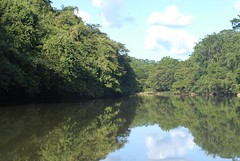
Going on a tour. We kayaked 14km down the River Macal, passing between forested hills, cruising over rapids and picnicking on a sand bank. We booked with a guy called D'Alessandro who was one of the guides who picked up on us in the central park. We chose him purely because he was friendly and not pushy. The kayak tripped consisted of D'Alessandro and his brother driving us 14km up the river, winding through beautiful farmland, where they put the kayak in the water and asked us to drop it off in San Ignacio just after the bridge before sunset. That was it.

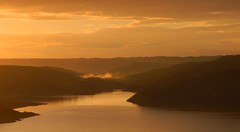
Macal River

Macal Mirror Pelvis

Eating at the South Indian Restaurant! Belizean food is much of a muchness so to find an Indian restaurant run by a guy from Kerala was a godsend.

Meeting the many very friendly, laid-back people of Belize.

Iguanas

14th December

Iguana spotting in San Ignacio, Belize

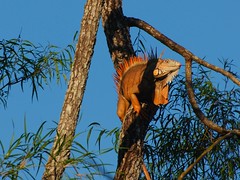
Iguana Sun

We spotted them first from our kayak. An unusual lump on a branch, high in tree. We hove to and saw it was an orange iguana, all menacing black stripes and spine spikes. Glowering it was.

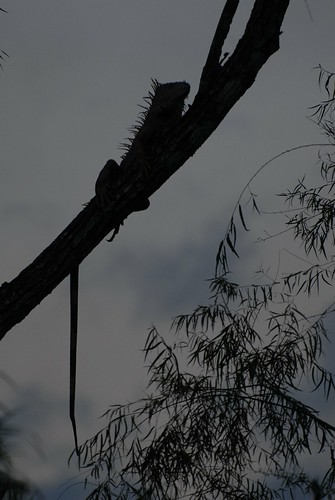
Iguana Profile

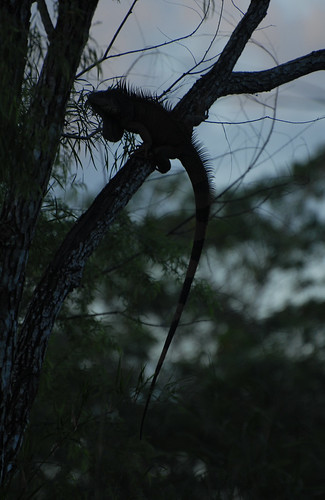
Once you see one iguana you start to see lots of them. On Friday evening just before sunset I counted 14 hanging out on branches, almost one in each tree over a couple of hundred metres alongside the river. They appear to be soaking up the last warmth from the suns rays before the cool of night. If you're in San Ignacio head for a riverside track a bit before sunset and get counting.

Danger Iguana

Mennonites

12th December

Mennonites 3

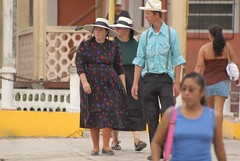
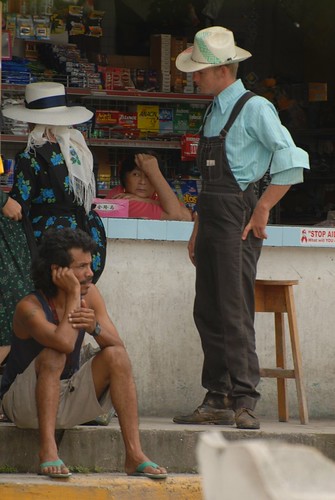
Belize is one country that is home to one of those old-fashioned German protestant communities who (mostly) left the present behind sometime in the 1700s. The Mennonites are akin to the more famous Amish. Formed out of German reformation thinking, they eschew most worldly goods, vanities and excesses for a simple life that is closer to their god. They live in distinct, even segregated, communities. We passed through one on the way from Indian Church to Orange Walk. Rows of prim, grey wooden houses, pinched white curtains at the windows, look out in orderly fashion across tidy fields with the occasional evergreen hedge for decoration. Horse-drawn buggies canter along the road, except when parked up under the veranda, and form the dominant traffic challenged only by the occasional Hispanic pick-up. Men and boys where work shirts, jeans and braces or dungarees and straw hats. Women wear loose dark dresses that come below the knee, and scarves or wide-brimmed straw hats.

Not all Mennonites are the same. While some refuse all modern inventions, so travelling by foot, buggy or bicycle, others drive cars and have mobile phones. In the north they wear more cowboy-like upturned hats, in the west the brims turn down. Some are clean-shaven while others have beards as shaving is a sign of bodily vanity.

The Mennonites are in Belize by invitation, arriving in 1962 from Canada after the Canadian government decided all residents had to be citizens. The pacifist, non-aligned Mennonites give no allegiance to secular nation states resulting in some problems up north. Belize needed skilled input to kick start its agricultural production and asked the Mennonites to come along. They now control something like 80% of all Belizean beef, dairy, poultry and egg production, as well as being major house builders.

Mennonites 2

Lamanai

11th December 2007

Lamanai

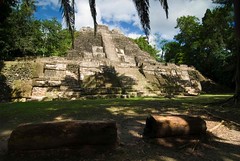
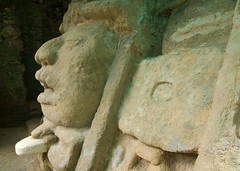
Lamanai is a Mayan city next to lagoons and amongst jungle in northern Belize. They are much smaller than Tikal, comprising a couple of beautiful restored pyramids, a ball court and some palace/administrative buildings around plazas. What mostly drew us here was an amazingly well-preserved white stucco mask – probably the face of a god or king – that had been preserved under a later pyramid until archaeologists discovered it in the late 20th century. The visit was well worth it, the 4 metre high mask being one of the best preserved in the Mayan world.

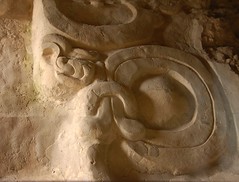
Lamanai Sun God Mask

We also enjoyed the excellent visitor centre and museum, howler monkeys, picnic lunch by the lagoon and photographing lots of delicate, gorgeous mushrooms found by Georgia.

On the Road to Indian Church

10th December 2007

We’re on the road again, Caye Caulker fast receding behind our speed boat ferry across a calm, blue Caribbean Sea. C.C. is certainly very much a resort island, nightclubs, sports bars and all. It was great for a week-long holiday. The snorkelling and weather were both good. We unfortunately moved hotels twice to get one decent and quiet – our second being a party venue next to a club – which was Lorraine’s well away from the town and right on the beach. We met some great people and had some great conversations on C.C. with Brits, Canadians, French, Germans and Turks.

A week feels like long enough so we are heading for a tiny village called Indian Church to stay a couple of nights an visit the nearby Mayan ruins of Lamanai. It feels like we’re travelling again rather than being on a long holiday.

We walked across Belize City to get a local bus to Orange Walk, a Hispanic-Mennonite town in the north. We had a three hour wait for the one bus to Indian Church – which runs twice a week – so had lunch, hung out in the central park, ate some crispy apple like fruit with salt, chilli and lime bought from a buy with a trike and got on the bus with everyone an hour before it left. The bus was packed with women returning from the market, children from a school, and a few men. The large, round-backed driver squeezed behind the steering wheel, edged forward, let someone on, edged forward, let someone on, edged forward then eased the bus onto the dirt road. Two hours down a rain-filled pot-holed muddy road running first between sugar cane fields then jungle, dropping off groups of perhaps three at one village, five at the next, and we were at Indian Church. Population 200, three shops (one the venue for watching TV), two comedors, two guest houses, a generator for electricity (only on between 6.30 and 9.30pm) and no light pollution.

Monday, 10 December 2007

Caye Caulker, Belize, Snorkelling

4-8th December

Coral, brightly coloured fishes, eels, rays, octopuses and turtles –one great tour company called Anwar and a wholly terrible, unprofessional one called Tsunami!

We have been Swimming with the Fishes…….or to be exact, swimming with the Yellow-Tailed Snappers, French Grunts, Pink Squirrelfish and Horse-Eyed Jacks. More Pirates of the Caribbean than fishes of the Caribbean? That’s what the coloured little fishes of the reef we have seen are called. We have seen large colonies of coral towering above the sea-bed, plus rays, eels, octopuses and turtles.

We have been doing what we mostly came to Caye Caulker for – snorkelling. And we love it. We’ve been out on three tours – and here’s a recommendation and a word of warning. Two tours by Anwar were good, one of them excellent. The third with Tsunami was appalling. We strongly recommend anyone who wants to go out with a good and knowledgeable guide to go with Anwar and to avoid Tsunami like the disaster they are named after. But more of this later.

Belize has the world’s second largest Barrier Reef, a line of coral than runs straight down the eastern coast and facing the Caribbean. It is broken places by natural channels and beyond it lies a series of coral and sand atolls. Caye Caulker is one of the sand islands – cayes – just inside the reef and only one of two that are inhabited. The local inhabitants have been long-time lobster fishermen until tourism took off. There is a largish local village sprawled along the key and a strip of hotels, hostels, restaurants, gift shops, jewellery stalls, dive centres and tour shops along the east-facing reef-side.

Two of our trips have been with the impeccable Anwar’s Tours, one with a fantastic guide and all-round top person called Emer. With enthusiasm, dedication and expert knowledge, he has pointed out pinnacle, elkhorn, antler, fire, brain and common sea fan corals. He takes time to point out corals, fishes, lobsters and eels then rises to the service to tell us what they are. He also takes time to answer all questions and explain how the reef works. He’s a star and if you go to Caye Caulker go to Anwar’s for a tour ans ask for one led by Emer if you can. He’s one of the best tour guides we have been with of any sort anywhere in the world.

Strangely the two Anwar’s tours have also been with the same Minnesotan couple celebrating her 60th birthday. We first went to the local Caye Caulker reef where we saw decent coral and some fish, second to Hol Chan and the Coral Gardens where we saw great coral and lots of fish.

We have also seen the entertaining, disappearing Christmas tree worms which do look like tiny, brightly-coloured Christmas trees. They disappear into their protective coral homes when they sense danger nearby. The corals rise as mounds from the sea bed, each mound a community of different types of hard an soft corals. Most are brown or green with a few purples and yellows thrown in to brighten things up.

Emer has dived to show us a multitude of multi-coloured fishes, the names of most of which are so quickly forgotten as one darting, bright treasure follows on from another. We have seen a variety of parrot, butterfly and angel fish, lots of sub-surface bobbing pipe fish, large shoals of silver and yellow fish hugging close to the coral, large black groupers, plus everyone’s favourite - the barracuda. Just floating looking down on the vibrant, three-dimensional worlds is enough of a delight to make an hour pass as if it is fifteen minutes.

Our third tour could not have been more of a contrast. The disaster that is Tsunami tours were the only company with a confirmed trip to Tunneffe Atoll, out beyond the barrier reef. The boat trip out was exhilarating due to the swell fronting strong winds. At our first stop Rene the guide swam off at breakneck speed leaving us all trailing in his wake. He pointed out only one fish but was keener to get to deeper water to harpoon his dinner. Half of the group were left behind, including three older, less fit Americans. Rene shouted at them to keep up and complained to me they should not be on the tour. A long swim later and we all made it back to the boat tired but the three Americans were struggling and Rene had to go back to escort them in. They only made it out of the boat one more time during the day.

We stopped on the sandy atoll itself for lunch and at three more locations to snorkel. Despite Tsunami saying the guide would show us coral and fish and that we could not snorkel by ourselves, Rene did not do any more guiding and either sat in the boat smoking cigarettes or went off on his own to hunt, bringing back a lobster and a fish. He also threw a live turtle in the boat for us to look at and shouted at one guy who put it back in the water as soon as anyone possibly could, poor turtle.

The large coral formations towering from the sea bed were stunning at Turneffe and because we had two good tours previously, both of us were happy to snorkel and look for things ourselves. We swam around colonies of different coloured corals, many with fish. But, not once did Rene offer to tell us where the good coral was, which direction to swim or how far unless we pressed him. Any of us could have gone too far and found a strong, cold current.

I hired an underwater digital camera from Tsunami which did not work the whole trip. When I brought it back, Heather who was running the shop was rude and offensive as she accused me of mistreating the camera while explaining that tourists lie to her and damage the cameras themselves. I said the memory card was faulty, in my opinion, which she worked out too while miserably bad mouthing tourists. Then refused a refund until she had checked with the woman who hired me the camera and we had to go back the next day to see if she would consider a refund. The whole attitude of Tsunami – their health and safety, guiding, communication and customer service was of the lowest standard you could imagine – in other words ‘utter shite’.

My highlights are the fish I’ve not seen before and long wanted to swim with.

We have had the honour at one location of being visited time again by a fly-past of at least 22 sting rays, silently gliding over the sea bed in graceful formations. A couple of larger spotted eagle rays have slipped past, their matt black bodies seeming to cast dark shadows across the water.


G. adds: yes... we have seen wonderful life under the water, and eagle rays are surely one of my favourite ever creatures on the planet to see. I loved the way that Emer pointed out all the little and more commonly seen fish as well as the 'big 5' so beloved of tour guides. the day after, I went back to Anwar's shop and spent an hour perhaps just sitting with the guide and browsing the reference books going over what we'd seen and identifying more or variations. They're a great outfit.
Sunday, 2 December 2007

Yaxha

The last weekend in El Remate before we go to Caye Caulker in Belize for a 10 day holiday. Can't wait.

On Saturday I visited La Blanca and Yaxha while Georgia worked on a couple of inHeritage comics. I was kindly given a lift by Lou, an American living in El Remate with half a dozen businesses and ideas for a hundred more. We met the archaeologists digging in La Blanca, were comically charged 80Qs for two lunches that should have been 40Qs and settled on 50Qs, then he dropped me off at Yaxha for the afternoon before returning to collect me after sunset.

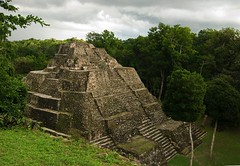
Yaxha is another fantastic jungle-clad Mayan city that has recently been renovated and had some great infrastructure added to it - wooden walkways and decent signs. It's right next to a lake too.

Here's some photos

Yaxha Pyramid
Yaxha Pyramid

Lake from Templo Mayor
Lake Sunset from Templo Mayor

Stucco Glyph
Stucco Glyph